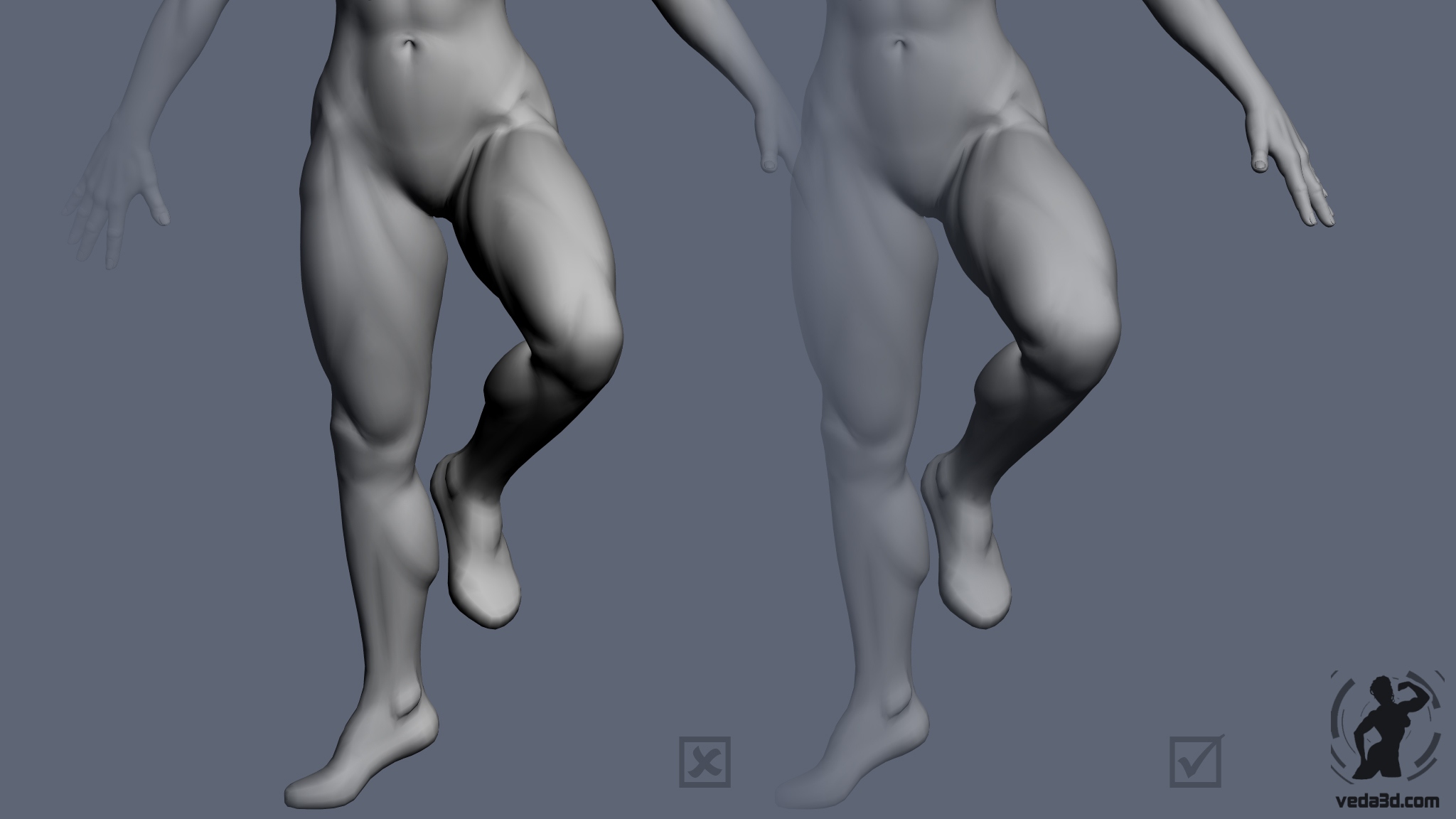
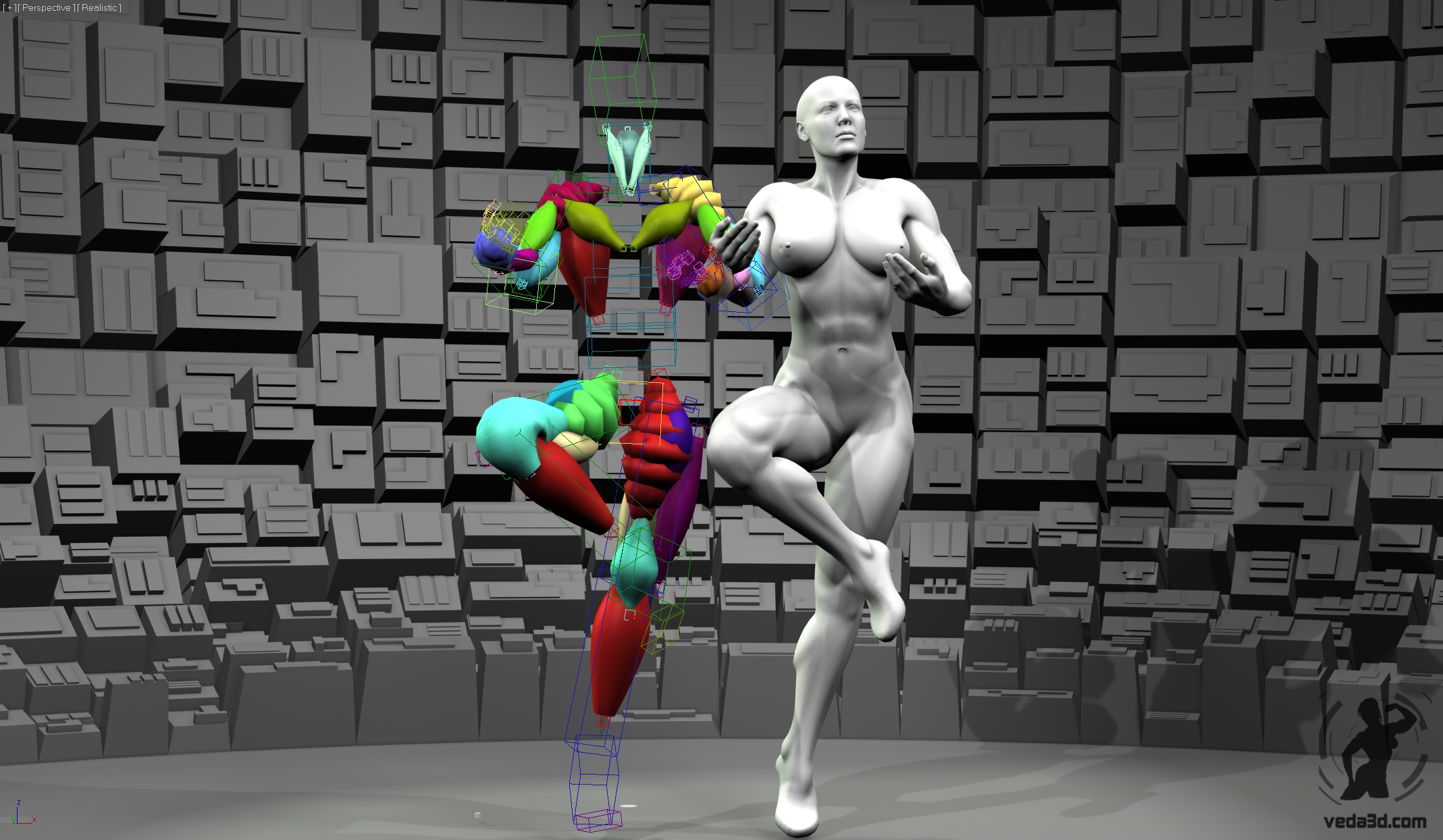
In the process of creating rig of knee it dawned on me that the MuscleStrand lacks one important feature – the possibility of expanding the muscle when it is bent.
In the area of the joint there is multilayer structure of muscles, and while it is bending some muscles are contracting increasing in volume. Stratifying on each other, displacing and contracting muscles give visual effect of extension of adjustment tissue by knee and elbow joints.
It is hardly possibly to create anatomically right muscle structure using MuscleStrand. That’s why I have replaced the whole group of muscles by MuscleStrand object extending it if necessary.
I attract your attention to the description of the techniques which I used at work CAT MuscleStrand in 3dsmax, creating Veda, and also additional instruments, what I specially worked out for this purpose.
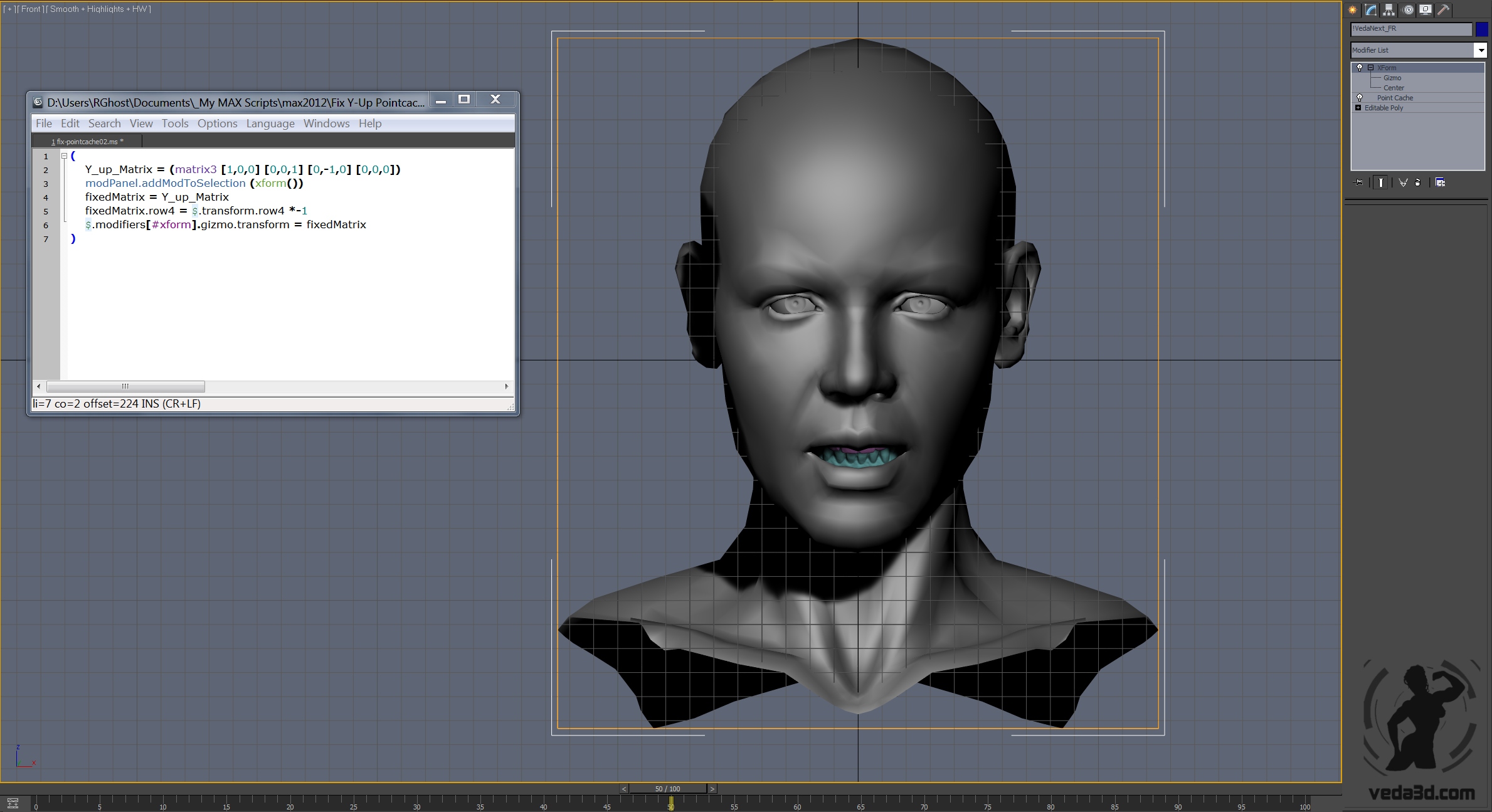
I ran into the problem of transfer of point cache data from Softimage Face Robot in 3ds max, 3ds max has in world coordinates Z-Up axis, while Softimage Y-Up axis. If you are writing point cache data in Softimage and then try to load it in 3dsmax’s PointCache modifier, then after the data is loaded (because mismatch axes) coordinates of the vertices are not correct and the model will seem inverted. This can be done manually using the snapping. To automate this process and avoid errors when working by hand, I wrote a small script that you can use in this situation.
Rigging To attain high-quality transformation of the body, it was needed that the rig be composed not only of bones but also of muscles. For the basic skeleton, Biped was chosen. The other variants were also considered. The CAT was …..
For creating hair it was used a standard component 3ds Max Hair and Fur. Hairstyle was created in a way, that allows to use a different methods for calculation of hair dynamics, but not only in built dynamics. At the moment as a hair dynamics engine it is used Flex modifier, which gives a good result for rather short calculation time.